

AI Sales Forecasting for Startups & Small Businesses: Stop Guessing. Start Planning.
If you’re a startup or small business, your “forecast” probably lives in someone’s head, a spreadsheet, or a CRM pipeline that isn’t quite real.
And that’s not a knock — it’s normal. You’re moving fast, deals shift weekly, and you don’t have years of clean data.
But when the forecast is fuzzy, everything gets harder, for companies not using AI forecasting for their start ups and small businesses you might be asking;
-
“Can we hire this month?”
-
“Do we have enough runway?”
-
“Should we spend on marketing or hold cash?”
-
“Are we actually on track… or just hopeful?”
This post shows a simple, practical way to build a sales forecast that’s accurate enough to run your business — and how AI helps you do it without living in spreadsheets.
What sales forecasting really is (for small teams)
A sales forecast is just a repeatable way to answer one question:
“What revenue is likely to close, and when?”
Not “best case.” Not “if everything goes right.”
Likely. And timed.
A good forecast gives you:
-
a realistic number for the month/quarter
-
an upside range if things break your way
-
early warnings when deals slip
Why startups & small businesses struggle with forecasting
1) Close dates are fantasy
Most pipelines are optimistic by default. Deals “close this month”… until they don’t.
2) Stages don’t mean anything
If one rep’s “Proposal Sent” is another rep’s “We talked once,” your forecast will always be wrong.
3) The process is manual
Spreadsheets become fragile. CRM reports don’t tell the full story. Updating takes time you don’t have.
4) One deal can swing everything
In small businesses, a single slipped deal can blow up payroll planning or marketing spend.
That’s why you need a forecast built for reality: simple, consistent, and easy to update.
The simple forecasting model that works (even with messy data)
You don’t need enterprise planning software. You need a system that does three things:
1) Weighs your deals realistically
Instead of “everything counts,” your forecast should reflect probability.
2) Predicts timing honestly
A deal that’s “likely” but 6 weeks out shouldn’t show up as “this month.”
3) Forces clarity
Deals without next steps or real momentum should not be driving decisions.
Where AI actually helps (without the hype)
AI doesn’t replace your sales brain — it removes the garbage work and makes your forecast harder to fool yourself with.
AI forecasting helps Start-Ups and Small Businesses:
1) Set smarter probabilities
Based on signals like time-in-stage, engagement, next steps, deal size, and past patterns.
2) Predict close dates more accurately
By learning how long deals actually take for your business — not how long you want them to take.
3) Catch risks early
Flagging stalled deals, sudden slippage, thin pipeline coverage, and “zombie” opportunities that aren’t moving.
4) Run scenarios fast
Base / Upside / Downside in seconds — so you can make decisions with confidence.
The minimum data you need (keep it tight)
You don’t need 50 fields. You need 6 that are consistently updated.
For every opportunity, track:
-
Deal amount (or ARR / MRR)
-
Stage (with clear meaning)
-
Expected close date (updated weekly)
-
Next step (specific action)
-
Next step date (scheduled, not “soon”)
-
Source (inbound / outbound / partner / expansion)
If you only fix one thing:
No next step date = not forecastable.
A weekly forecasting rhythm that takes 30 minutes
This is the part that makes it work.
Step 1 — Clean the pipeline (10 minutes)
-
update stages
-
update close dates
-
confirm next steps + dates
-
remove dead deals
Step 2 — Review the forecast (10 minutes)
-
what’s likely this month?
-
what’s likely this quarter?
-
which 5 deals matter most?
Step 3 — Run scenarios (5 minutes)
-
Base: what’s most likely
-
Upside: what has to go right
-
Downside: what happens if top deals slip
Step 4 — Make it actionable (5 minutes)
Assign owners to:
-
unblock top deals
-
create new pipeline (the easiest way to fix a forecast is more quality pipeline)
That’s it. Forecasting becomes a weekly business tool — not a monthly panic.
The 7 metrics that make forecasts improve over time
If you want a forecast that gets better each month, track:
-
Forecast vs actual (monthly + rolling)
-
Pipeline coverage (pipeline ÷ target)
-
Win rate (overall + by source)
-
Average sales cycle (by deal size)
-
Slippage rate (deals that move out)
-
Time in stage (stall thresholds)
-
Conversion by stage (what actually progresses)
These numbers turn your forecast from a guess into a system.
Common forecasting mistakes (and what to do instead)
Mistake: Forecasting based on rep confidence
Fix: Forecast based on stage evidence + movement + timing
Mistake: Counting every opportunity
Fix: Only count deals with momentum (next steps + recent engagement)
Mistake: One forecast number
Fix: Always show Base / Upside / Downside
Mistake: Only forecasting at month-end
Fix: Weekly updates eliminate surprises
When you’re ready for AI forecasting
You’ll know it’s time when:
-
you have 25+ active opps and it’s painful to keep updated
-
deals slip constantly and the team is surprised
-
hiring/spend decisions depend on getting the number right
-
leadership wants a forecast they can trust without debates
RoadMap Take: forecasting should give you your week back
The point isn’t to build a perfect model. It’s to stop wasting time in forecast meetings and start making clear decisions.
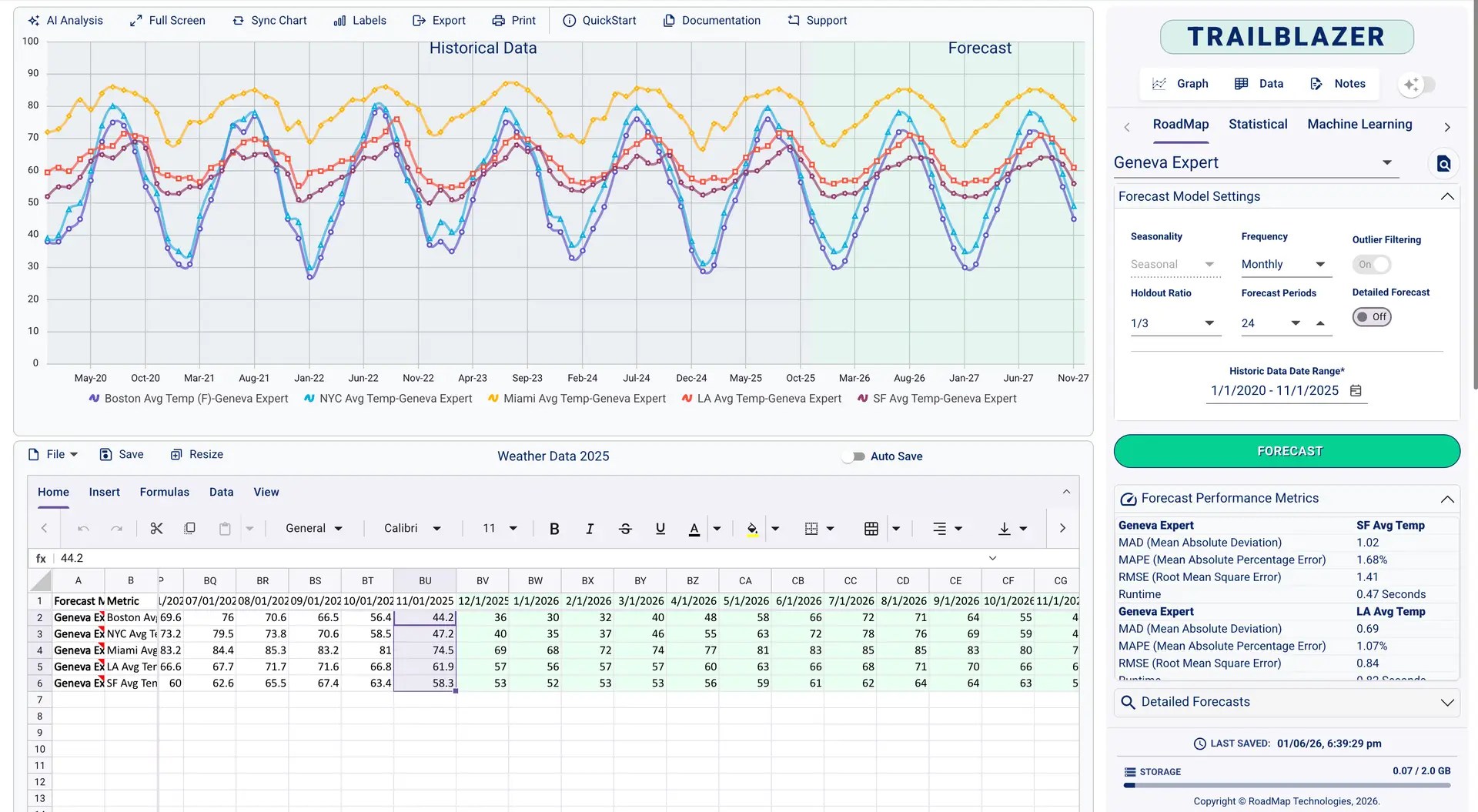
If your forecast feels like guesswork, we can help you turn your CRM + spreadsheets into a forecasting engine that:
-
predicts close timing realistically
-
flags risk before it hurts you
-
gives you base/upside/downside scenarios
-
and updates fast — without spreadsheet chaos
Want to learn more? Meet with RoadMap or Start a Free Trial of TrailBlazer at http://www.labofdata.com/products/trailblazer
Thank you for your response. ✨
FAQ
How accurate can a startup forecast be?
Accurate enough to plan — once you standardize stages, update weekly, and track slippage. It improves quickly with consistency.
Do I need years of data for AI forecasting?
No. Useful forecasting can run on pipeline behavior, timing patterns, and stage conversion — even with limited history.
What’s the best method for small businesses?
Pipeline-weighted forecasting with scenarios (Base/Upside/Downside). It’s simple and aligns with how small teams sell.
How often should we update it?
Weekly. That’s the sweet spot between “stale” and “noise.”
More reads
Find your ROI Potential
ROI Calculator AI and Conventional Forecasting for Start Up and Small Businesses