How the expert system works

A deterministic, rule-based statistical expert system engineered in C++. Every forecast is explainable, reproducible, and scored with holdout diagnostics.

  • Time & frequency diagnostics

    Geneva inspects series length, zero-demand intervals, variance stability, and spectral frequency to classify the underlying demand structure before fitting.

  • Seasonality & outlier filtering

    Automated pre-fit filters detect seasonal cycles and isolate one-time promotional spikes or stockout dips so a single anomalous period never distorts the baseline.

  • Parameter optimization in C++

    Instead of applying static textbook defaults, an optimized C++ search tunes smoothing weights, damping factors, and regression coefficients specifically for the series.

  • Rule-based best-fit selection

    Predefined expert decision rules built from decades of cross-client studies select the winning model and return MAPE, MAD, RMSE, Tracking Signal, and prediction intervals.

One engine across desktop, browser, and API

Whether planners run interactive diagnostics in RoadMap GPS or developers call the REST endpoint from Python or Claude MCP, the same Geneva C++ core computes the forecast, fit metrics, and prediction bounds.

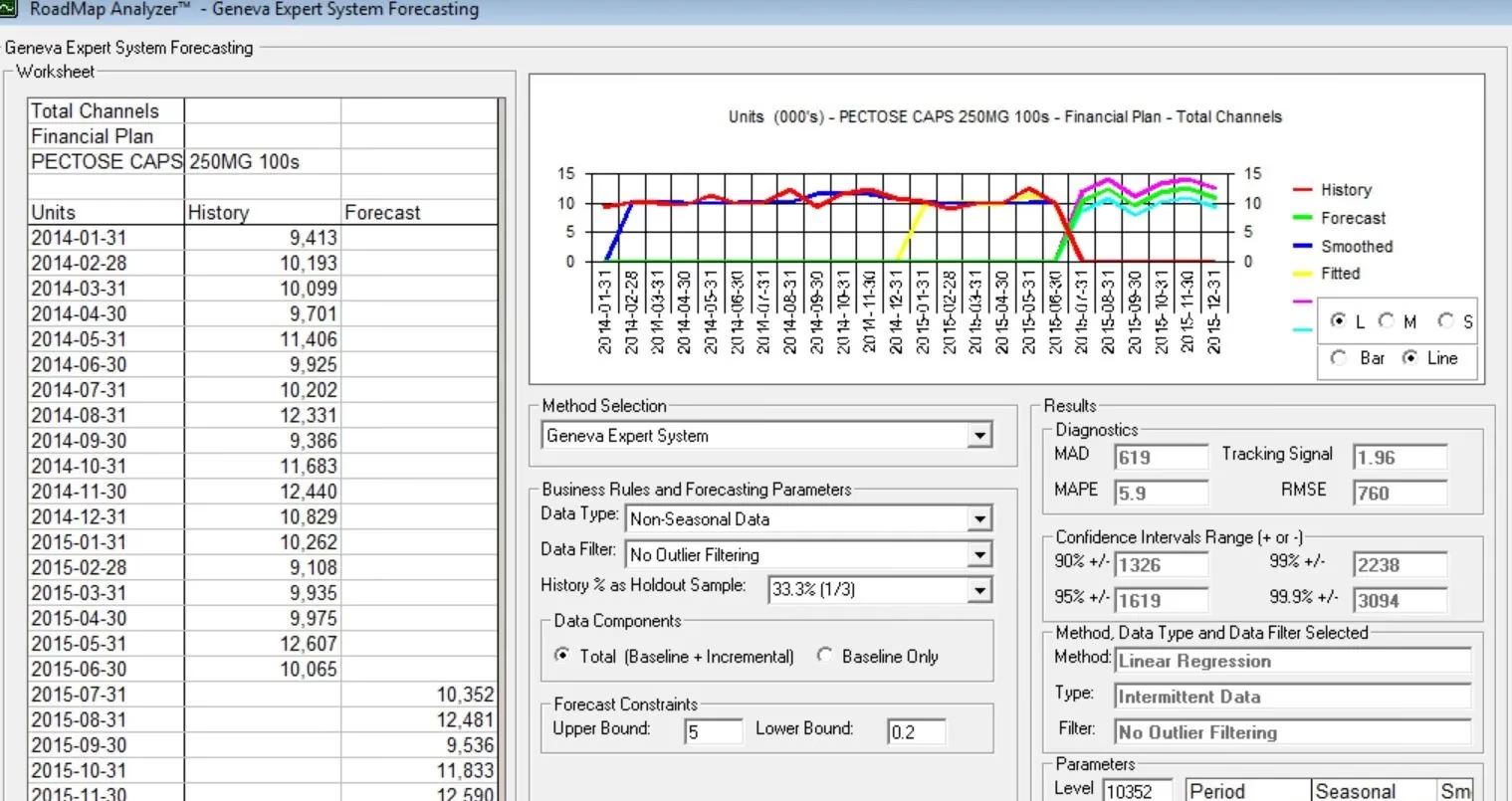
Geneva Expert System Forecasting inside RoadMap GPS showing historical vs. fitted vs. forecast curves, holdout sample validation, MAPE/MAD/RMSE diagnostics, and 90%/95%/99% confidence intervals.

Enterprise Desktop Diagnostics (RoadMap GPS)

Full transparency into the selected method, holdout sample error (MAD, MAPE, RMSE, Tracking Signal), and 90% / 95% / 99% confidence intervals.

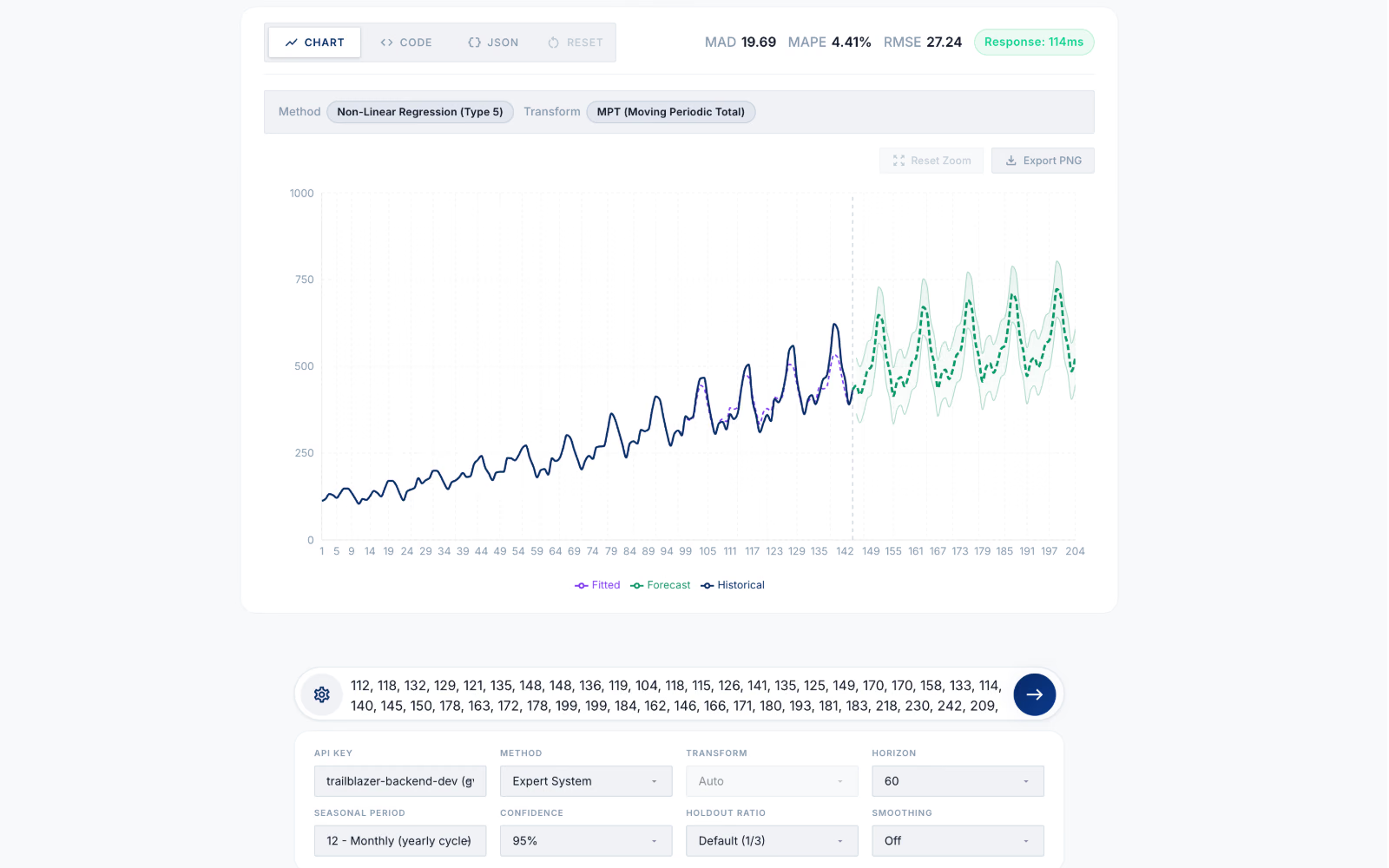
Geneva Forecasting API Playground showing interactive time-series forecasting, model selection, and sub-200ms JSON output.

Developer REST API & Playground (Geneva API)

Pass a time series via REST, Python SDK, or MCP server and receive the best-fit forecast, fitted history, and prediction intervals in under 200 ms on average.

The 10 statistical forecasting methods

Six regression forms, three exponential smoothing variants, and Croston's method for intermittent demand. Model forms 1 to 9 match Oracle's OLAP DML documentation; Croston's method is available in the Geneva API and RoadMap suite.

Regression Family

6 Models · Trend & Lifecycle Shapes

Captures structural long-term trajectories including linear baselines, proportional power growth, compounding exponential growth or decay, logarithmic tapering, capacity ceilings, and S-curve product launches.

Exponential Smoothing Family

3 Models · Level, Trend & Seasonality

Weights recent observations dynamically across single smoothing, Holt’s linear trend, and Holt-Winters triple exponential smoothing with damped trend and multiplicative seasonality.

Intermittent Demand

1 Model · Croston's Method

Decomposes sparse series into separate estimates of demand size and inter-arrival interval so slow-moving SKUs, spare parts, and specialty therapies are never over-forecasted.

The 10 forecasting methods in the Geneva Forecasting™ Engine
#Method & FamilyModel FormHow It Works & Best For
01Linear regressionRegressiony = a·x + b

Fits a straight-line trend through time. The baseline every other method has to beat.

Best for: Steady linear trend

02Power regressionRegressiony = c·xᵃ

Captures growth whose rate scales with time, curving up or flattening depending on the exponent.

Best for: Growth that accelerates or decelerates proportionally

03Exponential regressionRegressiony = c·eᵃˣ

Models a constant percentage change per period: compounding growth, or steady decay for aging products.

Best for: Compounding growth or decay (e.g. aging products)

04Logarithmic regressionRegressiony = a·ln(x) + b

Rises quickly at first, then levels off. Typical of adoption that saturates gradually.

Best for: Fast early growth that flattens

05Asymptotic regressionRegressiony = x / (a + b·x)

Approaches a fixed upper limit, useful when capacity or market size caps demand.

Best for: Growth approaching a ceiling

06Exponential asymptotic (logistic / S-curve) regressionRegressiony = cKeᵃˣ / (1 + ceᵃˣ)

The S-curve: slow start, rapid adoption, then saturation. The classic shape of a product launch.

Best for: Product launches and market saturation

07Single exponential smoothingExponential smoothingWeighted average of past values

Weights recent observations more heavily than older ones. Fast and robust for short horizons.

Best for: Short-term, non-seasonal data

08Double exponential smoothing (Holt's linear trend)Exponential smoothingSmoothed level + trend

Adds a smoothed trend term to the level, so forecasts follow a series that is rising or falling.

Best for: Trending, non-seasonal data

09Holt-Winters (triple exponential smoothing)Exponential smoothingLevel + damped trend + multiplicative seasonality

Smooths level, a damped trend, and a multiplicative seasonal pattern together. The workhorse for seasonal demand.

Best for: Seasonal data

10Croston's methodIntermittent demandSeparate smoothing of demand size and interval

Forecasts how much and how often separately, for items that sell in irregular bursts with many zero periods.

Best for: Intermittent / sparse demand (spare parts, slow movers)

Research origins & 25+ years inside Oracle

Born out of econometric research at Harvard Business School in the 1980s and battle-tested inside enterprise databases and Fortune 500 supply chains since 1988.

Founded 1988

Harvard, Stanford & MIT research roots

At Harvard Business School in the 1980s, Rudolph Pizzano III, Ph.D. saw that the leading econometric models of the era, despite their theoretical complexity, consistently underperformed on messy real-world business forecasts. He built the statistical framework that became the Geneva Forecasting™ Engine to handle the thousands of edge cases classical models miss, founding RoadMap Technologies in 1988.

In the 2000s, Prof. Frank Wolak of Stanford University, a RoadMap board member, guided engine design through his research on electricity market deregulation, while Dr. Evdokia Nikolova (Ph.D., MIT) extended Geneva to high-frequency 15-minute interval electricity demand forecasts.

Partner Since 1995 · Licensed Since 1999

The statistical engine inside Oracle

RoadMap's technology partnership with Oracle began in 1995. Oracle licensed Geneva in September 1999, shipped it in Oracle Express Server 6.3, and deployed it across the enterprise from 2000. Geneva served as the statistical core of Oracle OLAP, Oracle Demand Planning, and Oracle Retail Forecasting, and still ships today inside Oracle Database 26 OLAP DML.

“A best-of-breed statistical forecasting engine: Geneva Forecasting™ from Roadmap Technologies. Developed specifically for demand forecasting applications, this engine has multiple forecasting methods (linear and non-linear regression, variations of exponential smoothing), efficient parameter search and outlier detection algorithms, and a rule based system for automatic best fit forecasts based on time and frequency domain analysis and predefined decision rules generated from cross-client studies.”

Frequently asked questions

Is Geneva used by Oracle?

Yes. Oracle licensed the Geneva Forecasting™ Engine in 1999. It was the statistical core of Oracle OLAP, Oracle Demand Planning and Oracle Retail Forecasting, and it still ships inside Oracle Database 26 OLAP DML.

What forecasting methods does Geneva use?

Ten methods. Six regression forms (linear, power, exponential, logarithmic, asymptotic and logistic S-curve), single and double exponential smoothing, Holt-Winters, and Croston's method, plus automatic best-fit selection.

What is Croston's method?

Croston's method forecasts intermittent demand, meaning items that sell in irregular bursts with many zero periods. It smooths demand size and the interval between demands separately, which suits spare parts and slow movers.

Does Geneva need a GPU?

No. Geneva is a highly optimized C++ engine that runs on standard CPUs, averaging under 200 ms per forecast via the API.

Run Geneva on your own data

Get a free API key with 1,000 forecasts a month, launch TrailBlazer in your browser, or talk to us about putting Geneva to work in your S&OP cycle.